

Soulcraft Musings
Today, January 20, 2017, we inaugurate Soulcraft Musings, a new offering from Animas Valley Institute (see below). This is the same day America inaugurates a new president, a cultural upheaval currently mobilizing thousands of response teams worldwide. On this day we commence our humble project of Soulcraft Musings in support of the deepening, diversification, and flourishing of all life. At this time in the world, may we all inaugurate actions and projects that collectively give birth to a life-enhancing society.
Friday, October 23, 2026
A Map to the Next World, Part XXVI
This is Part Twenty-Six of a 28-or-so-part essay on making and following a map that might get us to the Next World, and on what it means to leave one world and eventually reach another, and on what it’s like for a community or a society to be between worlds, perhaps walking that long road for several generations. Think of this as a draft of an essay I’ll be working on for a while — or eventually a short book. Let me know — through Substack — what resonates with you. To fully understand or contextualize today’s part, you might want to read, reread, or at least scan the first three parts. Link Below.
This multi-part Musing makes up my second posting on Substack. It would be great help in this launch if you would become a Free Subscriber. (You can use the “no pledge” option when you click on the link below and then “Continue without pledging.”) Join the community: Click Here. After you subscribe, do check your email (including spam folder) to confirm. Thank you.
The Two Halves of Spirituality: Part I
Another essential element of our Animas map to the Next World is the recovery of the ancient pan-human knowing that there are two halves of any whole and intact spirituality: an upperworld and an underworld half. Either alone makes for an incomplete and possibly malformed spirituality.
The upperworld half of an intact spirituality is that which supports us to cultivate a personal, embodied, and authentic relationship with the mystery and holiness of the Whole, which is to say with the Universe, Spirit, the One, God, or Mystery. What is our personal experience of the Divine, of the enchantment and sacredness of all Creation, and how do we deepen and cultivate that relationship? Upperworld spirituality may also enable us, at times, to merge our consciousness with the Divine, an experience referred to as enlightenment, awakening, realization, insight, illumination, transcendence, the Buddhist nirvana, Zen satori, Hindu moksha, or Christian epiphany. I call this upperworld half of spirituality the Universal Transpersonal: the realm of the sacred common to us all. This realm celebrates three core miracles and enchantments among others: that anything at all exists, that there is a deeply imaginative and intelligent order to the unfolding of the cosmos, and that each of us are expressions of and co-creative participants in the Earth community and, for that matter, the Universe.
The underworld half of a whole spirituality, in contrast, is that which ushers us not up (and out) toward Spirit but down (and in) toward Soul, which is to say toward our unique ecological niche, the singular way that a human (or any creature) is in relationship to the Whole, to Spirit or Mystery — in other words, the particular place or niche we were born to occupy, the particular node on the web of life that is ours to embody. I call this the Individual Transpersonal.
Both the upperworld and underworld are transpersonal in the sense that they usher us into realms much bigger or deeper than the everyday conscious mind (the human ego). Trans-personal means “beyond the ego.” Spirit is much greater than ego because it is, after all, the Whole. Soul is much deeper than ego because it is the very core of our individual identity, our decisive meaning or significance, our raison d’être. Soul illuminates who we really are as individuals, who we were born as — an identity of which we have no conscious knowledge in our early years and may never know anything about unless we reach the life stage that enables us to embark on the journey of soul initiation. Soul, in other words, is entirely other than ego and a much deeper dimension of our individual identity — who we really are.
Spirit and Soul are both transpersonal in that they are deeply mysterious to the ego. And both are realms of the sacred. And neither are fathomable by the everyday strategic mind.
You can see that the two halves of spirituality, although distinct, are not separable (except perhaps to our rational minds). Given that everything is what it is by virtue of its relationship with everything else, any being or thing has the Soul qualities it does by virtue of its place or niche in the Whole, its relationship to Spirit. Spirit, in turn, is manifest only through the embodied and enacted Souls of things. Soul and Spirit imply one another, conceptually require each other.
But you can go through your whole life without ever having an experience of either Spirit or Soul. And you can have a direct experience of Spirit without ever having an experience of Soul.
But here is an asymmetry that might feel strange at first but goes right to the heart of what I mean by Soul and by soulcentric human development: You cannot have a direct experience of Soul that is not also an experience of Spirit, an experience of transcendence. Every experience of Soul — what we at Animas call Soul Encounter or what Thomas Berry referred to as inscendence — is also an experience of Spirit because Soul is our unique place, our singular individual niche, in the ultimate context of Spirit. Soul Encounter is not an experience of our place within smaller domains such as a family, friendship, romantic partnership, or human society. The “room” within which we encounter Soul is nothing less than Spirit. When we experientially encounter Soul, we are in the presence of the holiest of holies, the ultimate magic and mystery of the Universe; we are suffused with the enchantment of having a unique place in that unfolding Mystery. Maybe this is something like witnessing a solar eclipse and being bathed in the spell and charisma of our Solar System and even of the entire Universe, or perhaps it’s like being present at a birth or a loved-one’s death and being electrified by the aura of the Sacred surrounding and saturating us.
Transcendence is inherent in inscendence.
But not vice versa: Most contemporary people who have direct experiences of Spirit or of being merged with Spirit are not encountering their Soul at the same time. There’s nothing paradoxical about being in the “room” of Spirit without also encountering Soul. Soul Encounter, after all, does not take place until a person reaches a stage of life (the Cocoon, the fourth of eight soulcentric stages) that most people now never reach. But a direct experience of Spirit can and often does take place in stage three (psychological early adolescence) or even in middle childhood. Inscendence is not inherent in transcendence. But, for people in stages four or five (the Cocoon and the Wellspring), an experience of transcendence can catalyze or quicken an inscendence (Soul encounter).
Slowly it is dawning on us that the underworld half of spirituality has been expunged from or suppressed in all Dominator societies, at least from their conformist mainstreams, and that this took place, depending on the society, many hundreds or thousands of years ago — far outside your memory range and mine. I believe these erasures were perpetrated quite purposely. The underworld half of spirituality, after all, is the portal to true (initiated) adulthood, and Dominator business-as-usual is not possible in a society with a significant presence of true adults and elders (and vice versa). Mature (soul-initiated) people are not easily manipulated, conned, or enslaved and are naturally unwilling to give their lives to mind-numbing and life-destroying activities (the compensatory ambitions or pseudo-satisfiers of much of what we call “jobs” and “entertainment”); they are, after all, joyously busy enhancing the life of their greater Earth communities. Consequently, any first-generation tyrant’s first order of business has always been to eliminate the true adults and elders in their midst and among their neighbors and forbid and suppress the underworld half of spirituality. That, in a single sentence, is the main plot of the story of cultural genocide that has been perpetrated by tyrants worldwide against Indigenous people for the past 10,000 years. First you eliminate their capacities to defend themselves (disarm, imprison, and/or kill their warriors); then you murder their elders, ceremonial leaders, and initiators; then you remove the entire community from their traditional lands in which their culture is rooted; then you outlaw their initiation rites; then you subject them to missionaries who teach them an exotic “religion”; then you forbid them to speak their own language; and, finally, you kidnap their children and send them to distant boarding “schools” to be stripped of their native heritage, brainwashed by an alien and nature-disconnected worldview, miseducated, and prepared for a life of serving the machine and/or a life of addiction, depression, and early death.
Each one of us, regardless of our current cultural or geographical location, are descendants of nature-based peoples who once had intact underworld initiatory traditions, people who lived through some form of cultural genocide.
This story of genocide, however, may be nearing its end — in two ways: Most healthy soulcentric cultures have now been diminished or eliminated (with the possible exception of a few that are sufficiently remote and small in population), and global Dominator society, at least in its current form, has reached the threshold of undermining the planetary support systems needed for its own continuation.
Although most soulcentric cultures are gone, there are many ecocentric societies still with us. As a reminder, an ecocentric society is one that experiences its belonging as primarily rooted in its bioregion or watershed, a society that retains the core value of protecting biodiversity, of caring for the greater Earth community. To be soulcentric, on the other hand, is to hold the Soul as the center of individual existence and as our core guidance on what is worth doing in life. When we understand Soul as an individual’s innate place or niche in the greater Earth community, then we can see that to be soulcentric is a special case of being ecocentric. Ecocentrism is the soil in which soulcentric culture grows. When a culture’s soulcentric systems and structures have been diminished or destroyed through cultural genocide, its ecocentric substrate can still survive many generations and become the soil in which new soulcentric cultures might eventually grow. For societies that have lost their ecocentrism as well (like those of the Western world), the first goal is to reestablish that. Soulcentric restoration comes second. First to go; last to return.
The reestablishment of societal ecocentrism is the first of the two phases of our journey to the Next World that I described earlier in this essay (Parts XX – XXIII). The restoration of societal soulcentrism is the second phase (see Part XXIV).
* * *
Before ending today, let’s enjoy an interlude for a deep breath and a quick optimistic comment: Although most soulcentric cultures may have been subverted or destroyed, the reality of Soul remains fully intact in every individual human psyche and in what Rupert Sheldrake might call the morphic field of humanity and in the instincts and practices of a great variety of courageous and creative underground or culturally outlying traditions or movements scattered around the world.
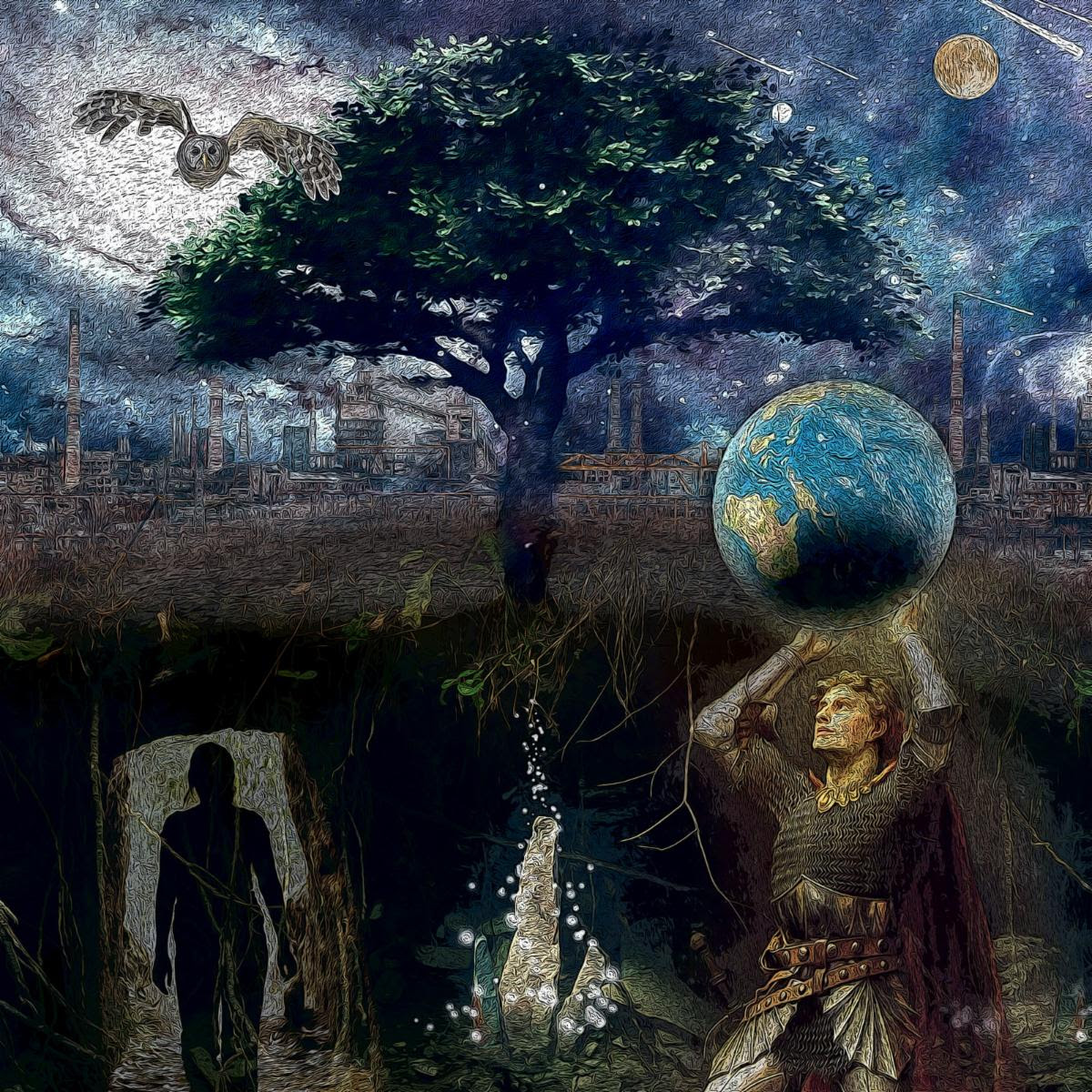
Photo: Inscendence as Doorway [Collage]. Doug Van Houten
To read previous musings click here.