

Soulcraft Musings
Today, January 20, 2017, we inaugurate Soulcraft Musings, a new offering from Animas Valley Institute (see below). This is the same day America inaugurates a new president, a cultural upheaval currently mobilizing thousands of response teams worldwide. On this day we commence our humble project of Soulcraft Musings in support of the deepening, diversification, and flourishing of all life. At this time in the world, may we all inaugurate actions and projects that collectively give birth to a life-enhancing society.
Friday, October 16, 2026
A Map to the Next World, Part XXV
This is Part Twenty-Five of a 28-or-so-part essay on making and following a map that might get us to the Next World, and on what it means to leave one world and eventually reach another, and on what it’s like for a community or a society to be between worlds, perhaps walking that long road for several generations. Think of this as a draft of an essay I’ll be working on for a while — or eventually a short book. Let me know — through Substack — what resonates with you. To fully understand or contextualize today’s part, you might want to read, reread, or at least scan the first three parts. Link Below.
This multi-part Musing makes up my second posting on Substack. It would be great help in this launch if you would become a Free Subscriber. (You can use the “no pledge” option when you click on the link below and then “Continue without pledging.”) Join the community: Click Here. After you subscribe, do check your email (including spam folder) to confirm. Thank you.
Technology, Cultural Breakdown, and Cultural Renaissance
Last week, I described the second of the two phases of the journey to the Next World: growing life-enhancing soulcentric cultures. I noted that we are likely a few generations away from being able to start that second phase, which itself will require several generations to complete. I ended by summarizing that there are no shortcuts to the Next World. It took several thousand years to spawn the planetary muddle we’re in now, so perhaps we shouldn’t be surprised if it takes a few hundred to extract ourselves. But it’s a blessing to be alive in a time when we can begin our migration and learn to navigate to the Next World.
Still, it’s hard to wrap our minds around the magnitude, scope, and depth of our twenty-first-century crisis — its sheer and brutal reality: Due to the psychosocial and spiritual degradation of so many societies over thousands of years, the majority of humans alive now are deeply disconnected from — and unaware of — the world we actually live in, an animate world of profound depths and meanings, a kinship world in which every thing and every being is what it is by virtue of its relationship to everything else. Most humans now are sleepwalking through the Real. Full stop. Yes, we’ve benefitted in profound ways from our ingenious human creations in technology, medicine, science, and the arts, but we’ve also suffered, for thousands of years, from systemic human-development oppression (SHDO), social systems, whether self-inflicted or other-perpetrated, that suppress our natural and full humanity, the oppression at the root of all other oppressions: racial, class, ethnic, gender, and religious. For millennia, most human societies have been navigating by cultural maps that have now culminated in the undermining of our planetary life supports — and in Earth’s currently unfolding sixth mass extinction.
I feel it’s important to take a pause here and ask if it really is all that bad, including psychosocially and spiritually. Haven’t we seen a lot of socioeconomic progress in our lifetimes and that of our parents and grandparents? Yes! Let’s acknowledge that over the last 75 years or so, despite the general trends noted above, there have been many encouraging prosocial and ecocentric advances in many places around the world. As Rebecca Solnit and others have been pointing out for years, [98] there are now rivers granted legal personhood (in, for example, Ecuador, New Zealand, Peru, and Canada); renewable energy technology and adoption is growing strongly and widely; in many places, coal-fired power plants are being shut down; many countries now recognize and support same-sex marriage; the rise of feminism has led to movements like Me Too; we are seeing strengthening campaigns for economic justice, anti-racism, and respect for Indigenous leadership; permaculture and regenerative agriculture are proliferating; people are learning about the dangers of tar sands and oil pipelines; white folk in communities across the US are organizing to protect their black and brown immigrant neighbors. These are real, meaningful, and encouraging advances, and they are moving us in the direction of more just and sustainable societies.[99]
But it’s also true that (a) we have a long way to go, (b) the life-destroying forces are strengthening simultaneously, and (c) most fundamentally, we have hardly begun to address what I believe is the root cause of all our troubles: systemic human development oppression. SHDO is hard for most people to see because each new generation accepts the world they inherited in their youth as the natural, normal baseline [100] — and SHDO has been the reality in most places for millennia. We need a deep-time perspective and an appreciation of nature-based full-spectrum human development to fully appreciate how much we’ve lost and how much remains to be recovered.
It seems to me that most of humanity has been navigating by Dominator maps even during epochs of extraordinary cultural flourishing such as the Axial Age (from 800 to 200 BCE in Asia, Europe, and the Middle East, the time of Confucius, Lao-Tse, Siddhartha Gautama, Zarathustra, Elijah, Homer, Parmenides, Heraclitus, and Plato), the Renaissance (the birth of modernity in Europe in the 14th to 16th centuries — think printing press, da Vinci, Michelangelo, Erasmus, Thomas More), the “Scientific Revolution” (16th & 17th century Europe: Galileo, Kepler, Bacon, Newton, Descartes, Hobbes, Spinoza, Locke), and the Enlightenment (“The Age of Reason” in Europe in the 17th and 18th centuries, with Rousseau, Voltaire, Kant, Goethe, Hume, Adam Smith, Benjamin Franklin). (All of them men in that list, woefully but not coincidentally; the repression, control, and historical erasure of women and the feminine is a core feature of Dominator World. [101]) In this long, highly diverse, multi-cultural unfolding, there have been multitudes of profound developments in the realms of science, medicine, technology, philosophy and ethics, cognitive models and abstract thought, politics and governance, the arts, spirituality and religion, psychology, economics and systems thinking, and our understanding of consciousness. Nevertheless, in hindsight, it appears that all of this has been within the context of societies that have been largely egocentric and psychologically early-adolescent. These developments, consequently, may have afforded enhancements in physical wellbeing, socio-economic status, education, and spiritual development, but mostly for those who have been and are self-focused (egocentric), human-centered (anthropocentric), and, across most cultures, primarily of a certain race, gender, class, ethnicity, and/or religion — and of only one species. The distribution of benefits has consistently been shaped by Dominator power dynamics and systems of hierarchy and inequality, such as colonialism, imperialism, racism, misogyny, enslavement, and patriarchy. These systems create frameworks of privilege and oppression that channel benefits toward specific groups while simultaneously marginalizing or exploiting others. In other words: egocentric and patho-adolescent social systems and structures. Meanwhile, some smaller societies with nature-based, egalitarian cultures have been supporting their people with full-spectrum human development, cooperation-based social structures, gift economies, and flexible gender roles, while living in sustainable reciprocity with the greater web of life. [102]
We might speculate, as many have, that the development of industrial, medical, and computer technologies has been a necessary stage of human evolution — or of human-technology coevolution.[103] Indeed, humans have co-evolved with technology over hundreds of thousands of years. The entire human story is braided with the innovations our ancestors have created, from the fashioning of stone tools and the knapping of knives and arrowpoints to the control of fire and the building of early shelters, from the development of sewing needles and glues to pottery and metallurgy. In recent millennia, new technology has been the main catalyst for societal change: the wheel, writing systems, the printing press, the steam engine, and, most recently, computer technology.
But it appears that the price we’ve paid has been the suppression or diminishment of our psychological, social-relational, ecological, and spiritual humanity. Consider the following signs of systemic human development oppression (SHDO) and cultural breakdown now found globally: a widespread questioning of self-worth; the impoverishment of purpose and meaning; existential anxiety and a sense of helplessness; pervasive emotional, moral, and spiritual crises; social fragmentation and an erosion of interpersonal trust; pervasive dynamics of deception, propaganda, and manipulation; the weakening of traditional values such as empathy and community; meaningless, repetitive labor and jobs that are mind-numbing and maturation-suppressing; widespread social violence and endless wars; anthropogenic ecological disasters and climate disruption; the development of weapons of mass destructive, including nukes, bio-weapons, germ warfare, engineered pathogens, and now AI; and totalitarianism, fascism, and the rise of surveillance societies.
Technological development may have been a core dimension of our human evolution, but in recent millennia, it appears to have gone hand in hand with widespread cultural decline, at least psychosocially and spiritually, even while ecological awareness, social freedom, and racial justice have increased in some places for some people.
Might it be possible to reclaim our full humanity without abandoning technology? Is it possible to grow more mature humans and healthier societies that provide guardrails for technology, limiting its use to life-enhancing purposes? The cultural shifts required for these achievements will be essential dimensions of the social structures and systems of the transitional life-sustaining societies discussed in recent weeks in this essay (phase one of the journey to the Next World — see parts XX – XXIII of this essay).
Perhaps we can have both science and Soul, religion and animism, philosophy and life-deepening ritual, the written word and oral storytelling, technology and life-enhancement, schools and actual education (vitality-centered learning that takes place not only within schools but also outside them and without them).
Once we gain enough clarity about the root cause of our current poly-crisis, we can and must orchestrate a root response: Systemic human development oppression calls for full-spectrum human development (or, more fully: nature-based, full-lifespan, multi-generational/ community-based, full-spectrum human development).
References:
[98] See, for example, her Hope in the Dark: Untold Histories, Wild Possibilities (Reprint ed., Chicago: Haymarket Books, 2016); The Beginning Comes After the End: Notes on a World of Change (Chicago: Haymarket Books, 2026).
[99] I’m also deeply encouraged when I read the bios of my Substack subscribers!
[100] This is known as the shifting baseline syndrome. One example is “environmental generational amnesia.”
[101] But see, for example, Janina Ramirez’s Femina: A New History of the Middle Ages, Through the Women Written Out of It (Toronto: Hanover Square Press, 2023); and Diana Robin, Anne R. Larsen, and Carole Levin, Encyclopedia of Women in the Renaissance.
[102] Consider, for example, ecocentric cultures described by Robin Wall Kimmerer (Braiding Sweetgrass: Indigenous Wisdom, Scientific Knowledge, and the Teachings of Plants), Paul Shephard (Coming Home to the Pleistocene), David Graeber and David Wengrow (The Dawn of Everything), Marshall Sahlins (Stone Age Economics), Pierre Clastres (Society Against the State), Kirk Endicott and Karen Endicott (The Headman Was a Woman), Richard B. Lee (The Dobe Ju/’Hoansi), Roxanne Dunbar-Ortiz (An Indigenous Peoples’ History of the United States).
[103] Edward Ashford Lee, The Coevolution: The Entwined Futures of Humans and Machines (Cambridge, MA: MIT Press, 2020).
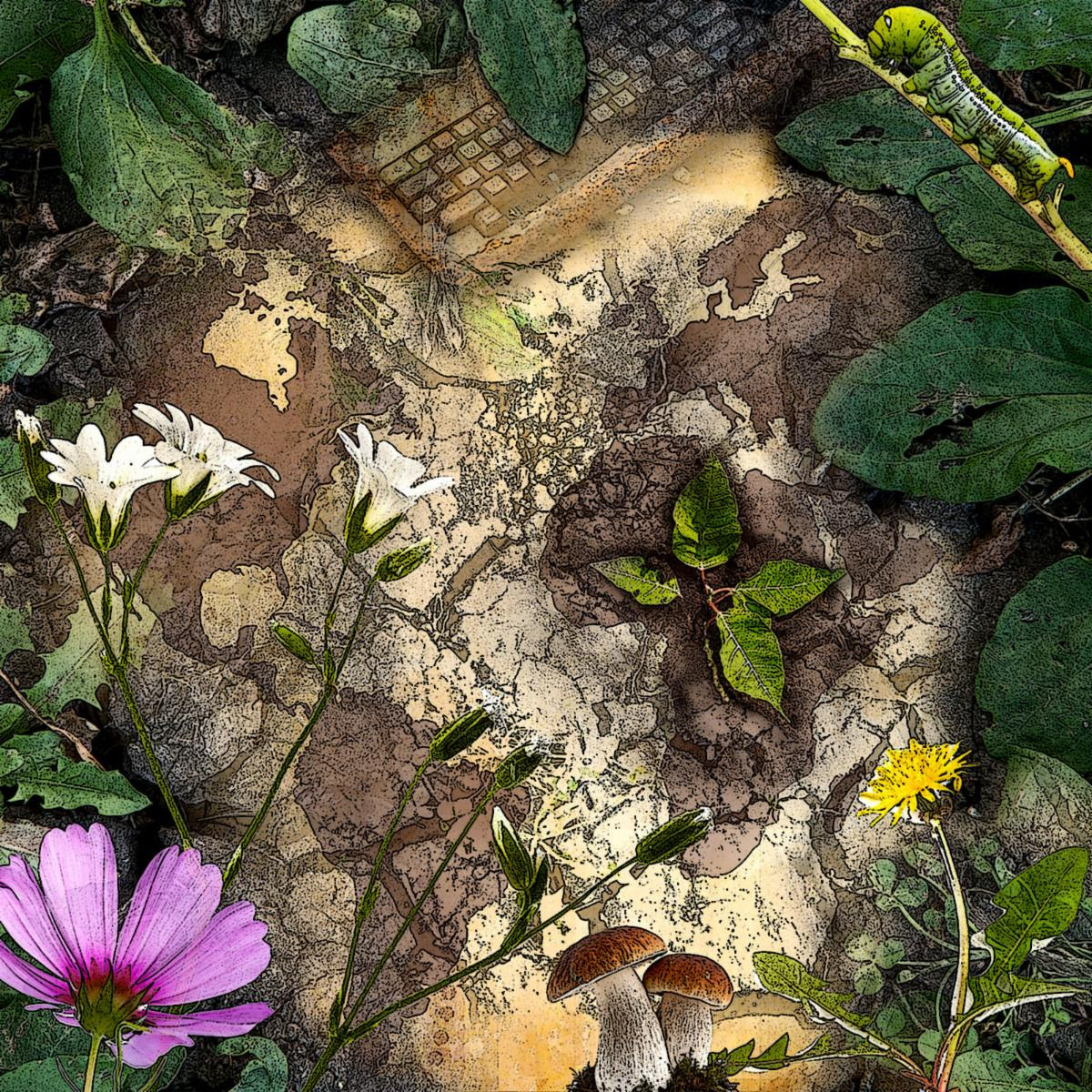
Photo: Where The World Dreams Through [Collage]. Doug Van Houten
To read previous musings click here.